


With only days remaining for Waikato councils to settle on their preferred merger models, Waikato District Council has backed a boundary following the Waikato River from Lake Taupō to Port Waikato.
Mayor Aksel Bech has named the catchment-based proposal Roto Ki Te Moana, meaning lake to the ocean.
The unusual shape reflects the path of the river and its catchment rather than forming a compact geographic area.
“Blame the river, really. It’s the path of the river,” Aksel told Raglan Community Radio.
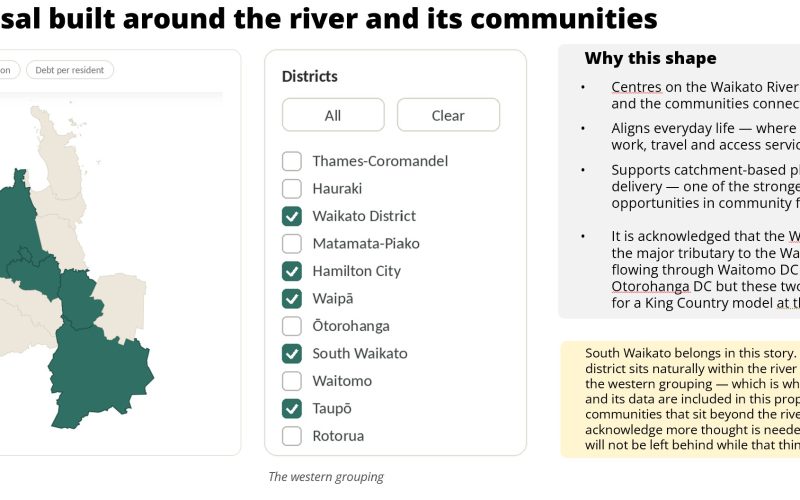
The proposed five-council authority would include Waikato District, Waipā and South Waikato, alongside Hamilton City and Taupō.
Aksel said the name also recognised coastal communities outside the river corridor.
“It recognises that not actually everyone is on the river. The coast is also important,” he said.
Waikato District Council is expected to formally vote on the proposal at a public meeting on Wednesday, 5 August.
Councils remain divided
South Waikato councillors voted this week to support the western model, joining Waikato and Waipā.
Support from three councils means the proposal has reached the threshold needed to proceed, but it does not mean all five have agreed on a shared structure.
Taupō has not selected a preferred option. Instead, it intends to set out a series of principles it wants respected in any future negotiations or Government-led backstop process.
Meanwhile, Hamilton says it would prefer a smaller authority involving Hamilton, Waikato and Waipā.
Taupō’s position is complicated by the district sitting across four regional council areas, leaving it pulled towards different parts of the central North Island.
Similar disagreements are playing out elsewhere in New Zealand as councils work to meet the 9 August deadline for locally developed proposals. Some regions are moving towards shared models, while others remain divided over boundaries, debt and how communities would retain their local voice.
Where councils cannot agree, central government will determine the final merger boundaries through its backstop process.
Aksel said he remained concerned about allowing the Government to make that decision.
“I still reject the uncertainty, the risk profile of letting government hold the pen. It’s just too high.”
He said Taupō remained central to the proposal because the Waikato River operates as one connected system.
“You can’t do a whole-of-river merger model without the whole of the river,” he said.
Managing water at Taupō during heavy rain could help reduce flood risks downstream, including at Port Waikato.
“It’s one river system.”
Catchment shapes the proposal
Aksel said advice from Waikato Regional Council and iwi had reinforced the importance of organising any larger authority around the river catchment.
“Regional council functions can’t be managed in isolation of the river and its catchments,” he said.
He said iwi settlements placed the Waikato River at the centre of decision-making and any new structure would need to avoid cutting across those arrangements.
Waitomo and Ōtorohanga are connected to the Waipā River catchment but have proposed forming their own King Country authority.
Aksel said including them in the current model would have required support from four of seven councils rather than three of five. However, their final place is not settled, and the Government could still direct them to join a larger authority through the backstop process.
The same uncertainty applies to Taupō. Although it has not endorsed Roto Ki Te Moana, Aksel believes a whole-of-river model ultimately needs to include the district. Whether Taupō joins would depend on the Government’s final decision if councils do not reach agreement.
Mutual distrust shapes council merger debate
The debate over amalgamation is increasingly focused on who would hold power in a larger authority.
Rural and coastal communities are wary of being dominated by Hamilton’s much larger population. Hamilton City Council, meanwhile, has indicated it does not want to be outweighed by surrounding rural districts and would prefer a smaller authority involving Hamilton, Waikato and Waipā.
Waikato District’s response to this concern has been to propose a four-tier governance structure designed to keep local decisions close to the communities they affect.
At the top, a unitary authority would handle major regional functions such as infrastructure, public transport, environmental management and regulation.
Beneath it, elected community councils could represent communities of interest such as metropolitan, coastal, rural or peri-urban areas.
Hamilton could have its own metropolitan council, while a coastal council could represent Port Waikato, Whāingaroa and Kāwhia.
The proposal says these community councils would have protected responsibilities and budgets, including the ability to set place-specific targeted rates and local service levels. They could also oversee parks, community facilities and placemaking.
Below them, elected local boards (similar to community boards) would receive minimum delegations and guaranteed funding. Those powers would be protected in legislation so they could not simply be taken back by the community councils or regional body.
At the most local level, community committees could include marae, catchment groups, hall committees and ratepayer associations.
Aksel also raised the possibility of restoring a town clerk-style role as a local point of contact for everyday services.
He described someone with a ute and tools who could repair a park bench without first sending the job through a costly central council process.
The proposal also intends to protect Māori representation within the new structure.
Who would govern the regional body?
The draft leaves open how the top regional body would be selected.
One option is for community councils to nominate representatives, although Aksel acknowledged this could leave people carrying two demanding roles.
Direct elections across an area stretching from Taupō to Port Waikato could create a different problem, particularly if significant power was concentrated at the regional level.
Aksel said candidates would need substantial funds to campaign across such a large area, which could favour wealthy candidates, major donors or people aligned with national political parties.
He said that could make regional governance more political and increasingly disconnected from the communities affected by its decisions.
The proposal suggests Hamilton’s representation on the top body could be capped at 50 percent, while community councils would protect representation for coastal, rural, Māori and metropolitan communities.
The challenge would be creating a regional body with the necessary governance skills while keeping it democratically accountable and connected to local communities.
Final votes approaching
Waikato District Council will formally vote on the proposal at a public meeting on Wednesday, 5 August.
Waipā is expected to vote the same day, followed by Hamilton City Council on Thursday, 6 August.
At the end of his interview with Raglan Community Radio, Aksel was heading directly into a meeting with Waipā Mayor Mike Pettit and South Waikato Mayor Gary Petley.
He said he expected many more conversations before councils made their final decisions, with Waikato and Waipā still hoping Hamilton would join the wider proposal.
“We’d much rather come into this holding hands,” he said.