



Debt warning raises questions as merger deadline closes

The Government’s three-month Head Start window for councils to develop amalgamation proposals has exposed growing tensions across the Waikato, as neighbouring authorities pursue competing models and some object to being included without their support.

The process was presented as voluntary, but councils that do not submit or join a proposal could still face reform through a Government-led backstop process. With the details of that process still unclear, councils have had to decide quickly whether to join a model, develop their own or risk having one imposed on them.

That pressure has contributed to a sharp dispute over the proposed Western Waikato combined council, backed by Waikato, Waipā and South Waikato district councils. Taupō District Council says it does not want to be drawn into the model and would prefer more time to explore a smaller merger with neighbouring central North Island councils.

The disagreement has become increasingly heated after Taupō Mayor John Funnell warned the proposed Western Waikato council would increase the district’s debt from about $900 per rating unit to nearly $9,000. This comparison is being questioned after council documents showed the two figures were calculated using different financial measures.

In a Facebook post, Funnell warned residents Taupō was facing a “financial raid” and claimed its debt would “skyrocket from approximately $900 per rating unit to nearly $9,000” if it was drawn into a Western Waikato combined council.

He also accused neighbouring councils of attempting to use Taupō as a “cash cow” to bail themselves out.

In its coverage of the dispute, the Waikato Times compared Funnell’s combative language with the rhetoric of former US president George HW Bush, Scottish rebel William Wallace and revolutionary Che Guevara. The comparison followed his declaration that he was “drawing a line in the sand” and would “fight tooth and nail” against the proposal.

Different ways of measuring debt

Taupō District Council’s financial report presents both gross and indicative net debt measures.

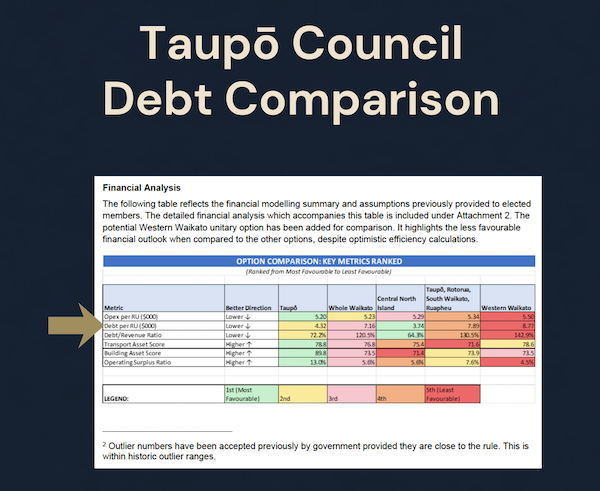
On a gross-debt basis, Taupō’s current debt works out to about $4,320 per rating unit. Using the same measure, the proposed Western Waikato authority would have debt of about $8,770 per rating unit.

The much lower $900 figure reflects Taupō’s position after accounting for its investment in Taupō Electricity Limited (TEL). The report says this is relevant because the fund is liquid and its capital can be accessed at relatively short notice.

The Western Waikato figure, however, is presented on a gross-debt basis and does not make an equivalent deduction for financial assets held across the proposed authority.

As a result, Funnell’s Facebook post compares Taupō’s indicative net-debt position with the proposed merged council’s gross-debt position.

Taupō’s own like-for-like gross-debt comparison shows an increase from about $4,320 to $8,770 per rating unit, rather than from about $900 to nearly $9,000.

However, the council’s broader financial case against the merger extends well beyond that comparison. Its modelling also considers operating costs, debt-to-revenue ratios, asset condition and operating surpluses, and concludes the Western Waikato option would leave Taupō in a less favourable financial position than remaining on its current footing.

Taupō officers also argue future borrowing, depreciation, renewals, operating costs and local spending would need protection to prevent cross-subsidies under any merged authority.

Proposal calls for existing debt to be ringfenced

Waikato District Council says the Western Waikato proposal recommends existing council debt be ringfenced rather than shared across the new authority.

Waikato District has itself acknowledged concerns about taking on debt from larger councils, particularly Hamilton. Under the proposal, borrowing raised by each council would remain attached to the communities that incurred it, with costs and debt allocated to avoid cross-subsidies between areas.

Taupō District Council agrees historical debt should be protected, but argues that ringfencing existing debt alone would not be enough.

Its report says safeguards would also need to cover future borrowing capacity, depreciation funding, operating costs, asset renewals, local spending and the rates used to fund those activities.

Without those protections, the report says communities could still end up subsidising investment decisions made elsewhere, even if their existing debt remained technically separate.

Mayor Aksel Bech also confirmed Taupō District Council had been advised on multiple occasions that the proposal’s intent was to ringfence each council’s existing debt.

Waikato District Council notes that the proposal does not prescribe exactly how debt would be managed if amalgamation proceeds. Instead, the detailed design phase would determine how financial arrangements could be structured to ensure communities are not unfairly disadvantaged.

Councils split over Head Start process

Waikato, Waipā and South Waikato district councils have voted to support the Western Waikato proposal, while Taupō District Council has opted not to submit its own preferred model.

Hamilton City Council has also decided not to submit a Head Start proposal, voting 12–3 against participating at its meeting on Thursday, 6 August.

RNZ reported that Hamilton Mayor Tim Macindoe had spoken with Local Government Minister Simon Watts before the vote. According to Macindoe, the minister indicated that councils endorsing a Head Start proposal would remain involved as models were developed, while councils entering the Government’s backstop process were unlikely to have the same opportunity to help shape the detailed models.

Macindoe said he would continue pushing for Hamilton to take part, arguing that decisions made by neighbouring councils would have significant consequences for the city.

Backstop details remain unclear

The Government initially described Head Start as voluntary, but warned that councils which did not participate could still face reform through a backstop process.

The Government has yet to explain in detail how that process would work.

Listen Live
News
Podcasts
Events