

Concerns about depleted shellfish stocks, pressure on accessible fishing areas and reports of people stripping sea life from rocks at night have prompted local fisheries kaitiaki Manihera Forbes to begin discussions about stronger protection for parts of the Whāingaroa coastline.
Manihera recently hosted a community meeting in the Raglan Town Hall supper room on behalf of Poihākena Marae, to discuss local fisheries issues, including reports from residents about night-time gathering, ongoing safety risks at Papanui Point and possible management tools such as a temporary closure and the establishment of a mātaitai reserve.
He says the discussion is grounded in kaitiakitanga, the responsibility to care for the moana and ensure kaimoana remains available for future generations.
Pressure on accessible kaimoana areas
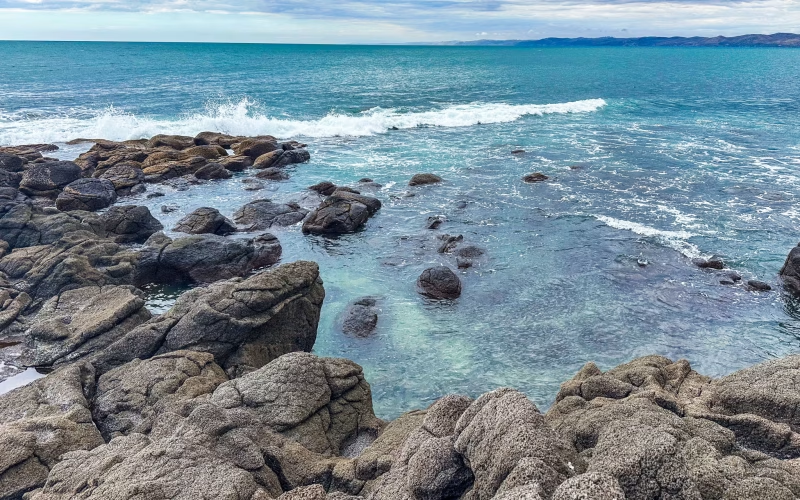
The coastline between Manu Bay and Whale Bay has long been important for local whānau gathering kaimoana, he says, but those areas are now under pressure because they are so accessible.
“I remember as a real young kid, my dad taught me how to dive, free dive in Whale Bay, and then go diving at Manu Bay and collecting kaimoana,” he says, recalling his younger days as a seven-year-old.
He says his aunties also shared stories of being able to walk down to familiar rock pools and collect kaimoana, with areas such as Manu Bay traditionally understood as nurseries for shellfish and other sea life.
Whāingaroa’s coastline is one of the most accessible areas for people across the Waikato, Manihera says, and that growing pressure is being felt in key gathering areas.
“A lot of people come here, and it’s awesome to be able to provide that, but when our stocks are down in key areas, we need to put in mechanisms that allow those areas to replenish.”
Customary tools being considered
Two possible tools were discussed at the meeting. The first is a temporary closure, which can close a fishing area for up to two years. The second is a mātaitai reserve, a customary fisheries management tool that can be used to set local rules around species, sizes and gathering methods.
Manihera says two-year closures are becoming more common around the North Island where local communities are seeing depletion.
“We always say just take what you need, but what has been seen is people are taking too much,” he says.
Once established, a mātaitai does not have a set end date and automatically prohibits commercial fishing. Manihera says there is no commercial fishing in the proposed area at present, but a mātaitai would allow the marae to create more specific customary rules for the area like, “Restrict taking of a certain species or restrict a method of take.”
Similar customary fisheries tools already exist along the wider west coast, including a mātaitai at Aotea Harbour, another at Marokopa and a taiāpure covering Kāwhia.
“These are already established along our coastline, and we feel it’s time to establish one for Whāingaroa too,” Manihera says.
He says the focus is primarily on shellfish and other easily gathered kaimoana from the rocks, rather than all fisheries.
“It’s all around our shellfish,” he says.
“All the easily accessible kaimoana that we’ve just seen the stock numbers really diminish on.”
Community input and monitoring
The meeting brought together recreational and commercial fishers, residents and people with local knowledge of the coast. Manihera says while there were different views in the room, the overall goal was shared.
“By and large, we all want the same thing. We all want our fishing stocks to be sustainable for future generations.”
He says the meeting was valuable because it allowed people to share information, experience and concerns before any formal proposal is finalised.
The information gathered will help shape decisions about how local fisheries are managed, with research and monitoring expected to be a key part of any future proposal.
Education and engagement part of solution
The conversation also touched on concerns about people gathering large amounts of sea life from accessible rocky areas, particularly at night. Manihera says MPI is responsible for fisheries compliance, but some residents raised concerns at the meeting that night-time gathering is difficult to monitor and can leave locals feeling they have to respond themselves.
He says education and engagement need to be part of the solution.
“We don’t want violence, that’s the last thing we want.”
The aim, Manihera says, is not to blame any one group, but to make sure everyone who uses the coast understands local expectations, safety risks and the need to protect kaimoana.
For Manihera, one of the next steps is to connect with communities who regularly fish at places such as Papanui Point, particularly those who may not have been represented at the recent meeting.
“There’s no point in us doing something and them not knowing about it or not understanding it and continuing their practices,” he says.
“So then it’s up to me to go and connect, go out and find them, and connect.”
Safety concerns at Papanui Point
Safety at Papanui Point is also part of the conversation. The area has been the site of repeated fishing-related tragedies and Manihera says some people who fish there may not fully understand the local conditions, hazards and risks.
“I’ve actually been part of the search and rescue team, searching around Papanui for bodies,” he says.
“It’s horrible to know that a pleasurable pastime that those guys had… now they don’t get to go home to their families.”
One of the closure ideas being considered includes closing fishing around Papanui Point, including rod fishing, as a way to both protect fisheries and reduce risk.
“It’s about how we can use these mechanisms in a smart way to manage our fisheries better, but also keep people safe,” Manihera says.
Next steps for the marae
He says the process has been underway within the marae since late last year, but any decision must be made collectively.
“The way we work is a collective decision, so we’ve got to take it back to them,” he says.
He hopes the marae will be in a position to communicate more clearly with the wider community about what it intends to propose to the Government within the next few months.
Manihera says the marae has also been doing research to support any application and to show the traditional practices connected with the areas proposed for closure.
He says the aim is not to stop people enjoying the coast, but to make sure the fishery remains healthy and accessible for the future.