



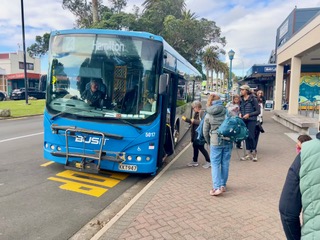
Waikato Regional Council is preparing to award new bus contracts that could leave Raglan with crowded peak buses, long gaps between services and the eventual loss of direct buses to Hamilton schools and the university.
The limited timetable affects residents travelling for school, work, appointments and study, while also leaving one of the Waikato’s major visitor destinations poorly connected to regional trains, intercity buses and airports.
Bus advocate John Lawson says the council has not abandoned its plan to end the cross-Hamilton services used by students. It has only delayed the change until partway through the new contract.
He is also questioning why councillors decided Raglan’s future service levels before receiving the full consultation report, which showed strong support for better weekend buses and recorded frequent disappointment from visitors about the limited service.
Student services still face cuts
Some Raglan buses currently continue beyond the Hamilton Transport Centre to schools and tertiary destinations on the northern and eastern sides of the city, including Fairfield College, St John’s College and the University of Waikato.
Last year, the regional council proposed ending those through-services and requiring passengers to transfer in central Hamilton.
Raglan families opposed the change, particularly because it would leave younger school students relying on connecting buses across the city.
The council agreed not to introduce the change immediately, but it remains part of its “medium-term” plan.
The new contract is expected to run for nine years from November 2027, with an option to extend it for another two years. The direct school and university services could therefore be removed after the contract is already underway.
For students, that could mean changing buses in central Hamilton and relying on another service to get back to the Transport Centre in time for the Raglan bus home.
A late or cancelled connection could leave them waiting for more than two hours because Hamilton buses run regularly, while services to Raglan are separated by much longer gaps.
John says the council listened to families’ objections but postponed the problem rather than resolving it.
Once the contract is operating, the council could argue that retaining the direct services would require extra funding, a contract variation or another vehicle.
John and Morning Show host Aaron Mooar pointed to an earlier overcrowding dispute in which students were being left behind and the council said providing more capacity would require it to fund an additional bus for the operator.
The concern is that the new contract could make the same argument available again: the council may decide now to remove the service later, then tell residents it is too expensive to change the contract once the cut takes effect.
Decision came before the full consultation report
John is also challenging the process used to decide Raglan’s future service.
Councillors approved the proposed regional service levels in late August. The fuller consultation report was not produced until the middle of September.
Although councillors had some information about the consultation, John says they did not have all the findings about what Raglan passengers, visitors and local organisations had requested.
The later report showed 60.4 per cent of respondents to the Raglan question supported a better weekend service. Despite that level of support, the improvement was not included in the plan.
By comparison, the council extended the Te Aroha service after 23.1 per cent of respondents supported it.
The report also recorded: “Visitors frequently ask about transport options at info centres but are disappointed by the lack of services.”
Those concerns had already been raised directly with the regional council by the Whāingaroa Raglan Destination Management Organisation, now Go Raglan.
In a June 2025 letter to regional councillors, the organisation said the Raglan iHUB received more than 12,000 visitors a year and warned that the withdrawal of public holiday buses during the busy Christmas and New Year period had left travellers stranded and caused them to miss connecting buses, trains and flights.
Charlie says the organisation received a positive response from the regional council, although the timetable and service improvements it requested have not yet been delivered.
It also requested better connections with Te Huia, including timetable changes, clearer information about connecting services and consideration of extending the route to Frankton railway station. The letter said those improvements would support both the community and responsible, sustainable tourism.
Go Raglan chair Charlie Young says “scheduling is an issue” from a tourism perspective and that a strong bus service is “essential” for a tourist town.
Go Raglan would like Raglan services to line up with Te Huia trains arriving from Auckland and would “strongly support any additional services”, he says.
John says the consultation findings about weekend demand and visitor frustration were not included in the information councillors received when they decided Raglan’s future service level.
He points to the timing of the process: councillors approved the proposed service levels in late August, while the fuller consultation report was produced in September.
John believes the outgoing council may have wanted to complete the decision before last year’s local government election. That has not been confirmed by the regional council, but he says the sequence raises legitimate questions about why councillors did not wait for the full report.
The missing information was important because Raglan already has crowded peak buses, long timetable gaps and growing demand from residents and visitors.
Raglan pays the same but receives less
The level of service also appears out of step with what Raglan ratepayers contribute and the town’s importance as a Waikato visitor destination.
Raglan properties in the main public transport rating zone pay $77.88 a year towards regional bus services.
Huntly, Ngāruawāhia, Cambridge and Te Awamutu pay the same rate but receive hourly buses.
Morrinsville receives seven buses a day, compared with five scheduled Raglan trips, despite carrying fewer passengers on average.
Two Raglan weekday trips leave at the same time, meaning passengers effectively have only four departure times. At weekends, when visitor demand is particularly important, that falls to three.
Pōkeno ratepayers pay $27.26 a year and receive an hourly service.
The Raglan route is also one of the busiest and most cost-effective satellite routes being tendered. John’s figures show it has the highest average passenger load and the lowest subsidy per passenger among the routes he compared, while receiving the least frequent service.
One reason given for the difference is that Raglan sits outside the Hamilton-Waikato Metro Spatial Plan area, sometimes called “Megatron”.
The regional council says Raglan has different service targets because it is outside that area, despite acknowledging the town is expected to grow and attracts high visitor numbers.
That means public transport investment is concentrated within the metro area, while a major regional destination outside its boundary remains difficult to reach without a car.
John says that approach overlooks the number of Raglan residents who depend on Hamilton for education, employment and essential services, as well as the demand created by visitors and the pressure they place on the existing timetable.
The council places an additional morning and afternoon peak service in the “medium term”. A two-hourly service is listed as a “long-term” goal and depends on future funding.
For now, Raglan remains a growing visitor destination paying the same public transport rate as communities with hourly buses, while residents and tourists face gaps of three hours or more between services and limited connections with the wider transport network.
A public meeting will be held at the Raglan Town Hall Supper Room at 4pm on Sunday 19 July. Councillor Lisa Thomson will discuss the issue and the roles of Waikato District Council and the Raglan Community Board, before attendees consider how to push for changes before the new contracts are finalised.