


The most notable news in 1926 was probably the opening of the first bank (apart from the Post Office Savings Bank), but news reports were again dominated by social events, roads, who should pay for them and the frequent crashes on them. The footbridge and Makomako school had opened in 1925, but 1926 was when they were formally opened, the now long forgotten Camp Fergusson began, new golf clubs opened and weekly steamers and the dairy factory continued.
The 1926 census showed Raglan’s resident population as 302, including 36 Māori, a rather larger village than in 1911, when it was 246, but far smaller than the 3,717 of 2023.
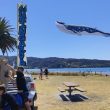
Bow St had lost most of its grass and been planted with phoenix palms in 1925.
At the annual meeting of the Raglan Co-operative Dairy Co, on 14 August, J.A.B. Hudson presented a petition, signed by nearly every tradesman in town, asking the directors to agree to support the first bank which opened a branch in Raglan. It’s not clear if it was coincidence, but 2 days later the Commercial Bank of Australia (CBA) announced it was going to open a Raglan Branch. Various changes later took place, including CBA and the Bank of N.S.W. amalgamating in October 1982 to form Westpac. After just over 90 years, Westpac closed in November 2016.
Although the first radio broadcast in the country was in 1921, George Anchor’s demonstration in the Town Hall on Saturday 12 June 1926, during a film interval and after the show, drew “a packed house”, to listen to San Francisco, Melbourne, Sydney, and Brisbane on a 5-valve set. “The loud burst of applause after the first few items drowned the remarks of the announcer, but afterwards the speeches given at the various stations were listened to with rapt attention until 11.30 p.m.” When Clem Beach put up his radio mast in 1929, he knew of only one other radio in Raglan. Median annual incomes ranged between £165 for a drover and £364 for a doctor, or animal trader (a much smaller range than today), so a £25 radio would have been more than most people earned in a month. Also mains electricity didn’t come until 1935, so a supply of batteries would have been needed.
Therefore newspapers remained the main source of information and musicians the main source of music, including the Raglan orchestra and Raglan Instrumental quartette, with frequent socials, concerts and dances. They included farewells to Te Hutewai School’s teacher, Miss Parker, Mr & Mrs E Langley, Mrs & Miss Bernard (on a trip to England), Mr E Sutton, moving to Dargaville post-office, Mr E Downs, manager of the Raglan Co-operative Dairy Co. moving to Te Puke Dairy Co, Mr & Mrs Alexander Baird, from the Harbour View Hotel and Mr. & Mrs. Edward O Wallis moving to Green Lane, Auckland.
Aquatic sports, postponed from New Year’s Day due to weather, were held off the stone wharf on 29 January, followed by a concert and dance in the Town Hall. A greasy boom on the front of a dinghy was still part of the fun.
A concert and dance in Te Mata Hall raised money for the school picnic, later held at W. J. Saunders’ house. Raglan and Te Hutewai schools had their picnic in Kopua Park, Okete Sunday School had theirs on Okete beach and Waitetuna School Christmas party, races and games were in their adjoining paddock, followed by a high tea. Te Hutewai had a euchre party and dance in the school that night.
A concert, with piano and Japanese fiddle, and a dance for library funds was held in Te Uku Memorial Hall, the bachelors of Te Uku, Waitetuna and Okete had a ball there with the Raglan orchestra and dancing until 2 am and it was used for a Harvest Festival, followed by a musical social, the funds going to the Methodist Circuit. A musical evening in Raglan Congregational Church was also by the Raglan Orchestra, adding £5 to the parson’s car fund. A Squadron, 4th Waikato Mounted Rifles had a Hamilton jazz orchestra at their Town Hall ball, with dancing till after 3 am.
Raglan Golf Club held an evening dance in the Town Hall on the opening day of its new Lorenzen Bay course, making £3 for the club. Prior to 1914 golf had been played on the Somerset farm, Mangatawhiri Road, later owned by John Cleave, and on Albert Richard Langley’s farm at Lorenzen Bay. Two 9-hole clubs opened in 1926. The first was on 19 May at Kauroa and then in June, on Charles Ralfe’s farm, Lorenzen Bay. The first tee was where a P & T depot later stood, with the fairway parallel to the road and extending to Greenslade Rd. It was replaced about 1928 by a course on the farms of Bob and Frank Gibbison at Kauroa, later by the airfield and is now on Te Hutewai Rd.
Raglan Lawn Tennis Club continued to thrive, as did Okete, Te Mata, Te Uku and Waitetuna clubs. A social and dance in aid of the tennis club funds was held in Te Uku Memorial Hall on Friday, 22 October. In November Raglan tennis courts said they were an asset to the district, especially for summer visitors, yet paid £18 in rates. RCC decided to vote £5 a year to the club. A “Paddy’s Market” raised £45 for a children’s tennis court.
Raglan Horticultural Society’s annual show was reported as one of the most successful in the society’s history, the roses being particularly good and their patron, the Reform MP for Raglan, Richard Bollard, presented a silver cup for annual competitions. However, Raglan Agricultural and Pastoral Association, which had started in 1903, but had a poorly attended show in 1924, decided to remain dormant for a time and was never revived.
In September a Cobweb Fair at the Hamilton Y.M.C.A. (a name used by Australasian non-conformist churches for their fairs in the 1920s and 30s, decorated with cobwebs and once described as stallholders being the spiders and the buyers as the flies) raised money towards buying a community camp site at Okete, for which E O Wallis sold his 13 acres for £1,000. Dr Spencer said at its official opening on 13 December 1926, “the youth of the present day demanded an outlet. Home life had, to a large extent, disappeared.” Camp Fergusson was bought following an appeal by the Governor General, Sir Charles Fergusson. £100 was also raised by Hamilton Rotary Club members and the balance by trustees, including the Mayor of Hamilton. It was described as, “ideally situated, providing many natural facilities for camping, fishing, boating, fresh and seawater swimming, recreational grounds for games and open and bush covered country. A regular timetable will be followed in camp and will include physical exercises, swimming, boating, tramps, mountaineering, cricket, football, athletic sports, over-night camps and concerts. It is also anticipated that a wireless set will be installed at the camp”. About 30 men from Hamilton built a cookhouse, boat-house, drainage, a ram pump for water supply and a flagpole. The camp was used by Scouts, Guides and other youth groups.
It was run by a committee of Hamilton Borough, Public Schools Headmasters, Rotary Club, Scouts, Guides, YMCA and Hamilton churches, whose aim was “future citizen building . . . under proper and wholesome discipline”. They reluctantly agreed to holidays for poor children, but only on condition of “strict order and discipline”, Due to that reluctance, William Paul (of Paul’s Book Arcade) and Hilda Ross (later a National MP and Minister for the Welfare of Women & Children) set up Port Waikato Children’s Camp League in 1929. Use of Camp Fergusson rapidly declined and by 1933 it was said Okete was not suitable for a community camp site and an attempt was made to sell it. The Hamilton Mayor said he was very disappointed to find that what was thought to be an ideal site was now regarded as unsuitable. He suggested that the Waikato Camp should be asked to take over. A 1937 report said it fell into disuse and in 1938 Hamilton Borough transferred Camp Fergusson, to the League. The camp was 5.26ha. Waikato District Council now owns 4.86ha Okete Nature Reserve, beside Okete Falls. Is this the same site?
Discipline for boys also seems to have been an issue in July, when the Raglan Town Board resolved to put a stop to boys rolling motor tyres about the streets and riding bicycles on footpaths.
Another aspect of the period came out in a June 1926 report, that in the UK general strike most members of the Heitiki Club, (a club of Kiwis living in Cambridge, UK) were engaged in service to help the Government. One was Joseph Peart, of Raglan, who spent 5 days driving London buses, which he described as a wonderful experience.
Driving was becoming more common, 1926 car registrations being up by 16% from 1925, so that the country had 123,396 motor vehicles and 1,379,487 people. Highway district No. 2 (of which Raglan was part) had 11,437 vehicles and a population of 110,410. Cars were expensive; one advert offered to exchange a 2-seater car for a seaside section, so it was still only the richest 10% of people who had a car, but for the year ending March 31, 1926, Raglan County (RCC) spent a record £49,000 on roads, mostly metalling. As today, grants from the government covered half the cost, and RCC also raised funds by levies on heavy goods, such as coal from Campbell Coal Co, Whatawhata and timber from Raglan Sawmill Co.
The largest grants went to the Raglan-Hamilton road where, “sharp corners in the gorge have been cut back, and the road widened with the spoil”. Many local quarries were mentioned, including Bear’s, Bull’s, Coleman’s, Dawson’s, Deviation, Rawlinson’s, Ryman’s, Street’s, 10-mile and Wapp’s and gravel was scooped from creeks for Cogswell Rd, and the new Waitetuna Valley Rd, except that the last mile (the link to Fillery Rd was still half a century away), which was, “in a shocking state, being knee-deep in mud”. A filling near Te Mata store was formed on a 3ft concrete culvert. Bryant Home for convalescent children (now the Bible Camp, Wainui Rd), which had had to close for several months in winter, as a mile of road was too muddy, got a £600 Ministry of Health grant and by September Bryant House Road was fully gravelled.
At the end of 1926, when the Health Minister, Alexander Young, spent a week’s New Year holiday in Raglan, he said he had been greatly benefited by his stay, but accepted some scheme of seasonable supervision of sanitation in the closely-peopled parts was essential, if Raglan was to preserve its good name as a holiday and health resort. However, he said a water and sewage system would be very desirable, but was “quite beyond their resources and well out of the question”. It was reported that shortage of water was inconveniencing holiday makers, who depended on tanks. Although the improved road had diverted business to Hamilton, he thought it was compensated by more visitors, “many of whom would erect seaside cottages now that convenient access had been assured.” There were more visitors in Raglan during the holidays than locals.
In September Charles Swann resigned as councillor for the Karioi riding, as there were so many clay roads that required attention that he hadn’t time to deal with them. William Vernon was elected to take his place.
Heavy loads on the poor roads caused controversy. In August RCC decided to limit the Whatawhata-Raglan road to lorries and loads of up to 4 tons. They decided not to bridge a bog on a road to a farm which took its cream 28 miles, though there was a dairy factory only 2 miles away and milk prices the same. H. H. Sterling, the NZ Co-operative Dairy manager took strong exception, writing “We are not aware whether our company is primarily affected by this action on the part of your Council, but as a matter of principle we think that your Council should not, in the allocation of its expenditure, take any account of the company to which any particular settler desires to send his produce, and more particularly we would suggest that it is entirely outside the province of your Council to take into consideration the financial return per lb of butter-fat received by any settler.” RCC argued those rates were being spent on the main road to Hamilton and that a bridge to the farm had simply been deferred. They also noted Te Akau cream was carted 30 miles to Ngāruawāhia, though Raglan was only 8 or 10 miles and they said the back carting of manures was more serious still.
On 19 January two cars crashed at a bend on the Hamilton side of the deviation and, nearby, on 23 April, Dr. Averill, the Archbishop of New Zealand, was in another head-on crash after running a confirmation service in Raglan. There were no serious injuries.
Raglan had three Anglican vicars in 1926. In March the Raglan-Kawhia-Waingaro parish was divided into a northern half of Pepepe, Waingaro, Raglan and Aotea, and a southern part, with Kawhia and Otorohanga. Rev. C. J. Bush-King, who had been filling in, following Rev. Clarence Seton’s departure in 1925, took the southern area. He was said to have performed a record in reaching Kawhia on Christmas night, after having conducted morning and afternoon service at Raglan, Te Mata and Te Uku in a day. The reporter wrote, “Truly he spares neither himself nor his car!”
In January Rev. Jim Beaufort moved from Hauraki Plains to take over in Raglan. He was described as young, friendly and a good mixer, was in the Air Force during the 1914-18 war and then completed his Anglican Church studies. In August he left to join the Navy as chaplain on Philomel. He was later a master at King’s College, and in the 1930s was Joint Headmaster and founder with Mr Broadhurst of St. Peters’ School, Cambridge. He was replaced in September by Rev. G. A. Young. He was from England and a master at a Marton private school until the Great War, when he became a private. He was ordained by the Bishop of Auckland in 1919, was Assistant-Priest of St Mary’s, New Plymouth, vicar of Whangamamona, went to Shannon in 1929 and returned to England in 1934.
In September there was also change in the Congregational Church. Pastor Daniel Benton, who came in 1925, was replaced by Rev. James Smeeth, from the Whangaroa Methodist Circuit.
Doctors changed too. In September Dr. Cashmore resigned from the Raglan District Medical Association to take a post-graduate course at British hospitals. He was followed for a few months by Dr Lange.
Dr. Cashmore had chaired the annual meeting of Raglan Rugby Football Union in May, Teams played included Moerangi, Te Akau, Te Mata and Hamilton, who were entertained to dinner at the Harbour View Hotel. However, in August a Raglan-Kawhia match was abandoned, due to the death of one of their best players and “the apathy of the Northern S.S. Co. in providing a steamer”.
On 17 July, whilst playing football, Sidney Raymond Death, Waingaro, aged 28, died soon after a Raglan v United of Hamilton game started. A post mortem found he died of sudden heart failure due to fatty degeneration of the heart.
The dairy factory on Wallis St was still doing well. A 1200 gal. cork-insulated vat was built, there were 145 suppliers and F. V. Stewart, who’d been manager of Oparau Co-op. Dairy Co, became manager of the Raglan Coop. The ongoing contest between Frankton and Raglan factories continued. Intermittent rain in October and November delayed shearing so the first sales of the season were missed. Possibly the rain also accounted for the lack of reports of bush fires.
Changes were reflected in the port returns, with increases in butter and wool tonnages, offsetting other losses –
| Year | Wool | Dairy | Flax | Timber | other goods | Total | Number of ships |
| 1925 | 246 | 196 | 9 | 122 | 103 | 676 | 53 |
| 1926 | 266 | 263 | 13 | 53 | 125 | 720 | 54 |
| 1927 | 271 | 340 | 28 | 105 | 144 | 888 | 55 |
The 1898, 412 ton, ss. Rimu (though replaced for several months by Ngatiawa, or, when she was bar-bound, by Arapawa) was still running a weekly Onehunga-Raglan- Kawhia service, with the usual delays; for example, one report said she “took aboard huge seas when crossing the Manukau and Raglan bars. A large quantity of benzine (deck cargo) was swept overboard, while some members of the crew were seriously rough-handled by the storm. Great seas swept the decks, and a stud ram (consigned to Mr Keith Mackenzie) was allotted a saloon passage to escape threatening danger. . . William Downey, chief cook of the steamer Rimu, . . . when the ship reached Raglan Mr. Downey was examined by a doctor who found he was suffering from a broken hip and bruises”
In 1926 Northern Steamship’s 1906, 451 ton, Ngatiawa called at Raglan several times
Although RCC asked the shipping companies to lower the price of wharfage on manure from 1s to 6d a ton “to meet outside competition”, it seems that shipping was still accepted as the main carrier of goods, because another report said an extra sailing had been put on for the first wool sale of the season and remarked, “some bales were even taken to Hamilton by lorry and trucked down by rail”.
The Department of Lands & Survey decided to end the £30 a year Te Akau-Raglan ferry subsidy, paid since 1913, 1370 passengers used the ferry in 1926. It continued until at least 1944, with £20 from RCC and £10 from Raglan Town Board.
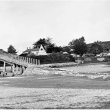
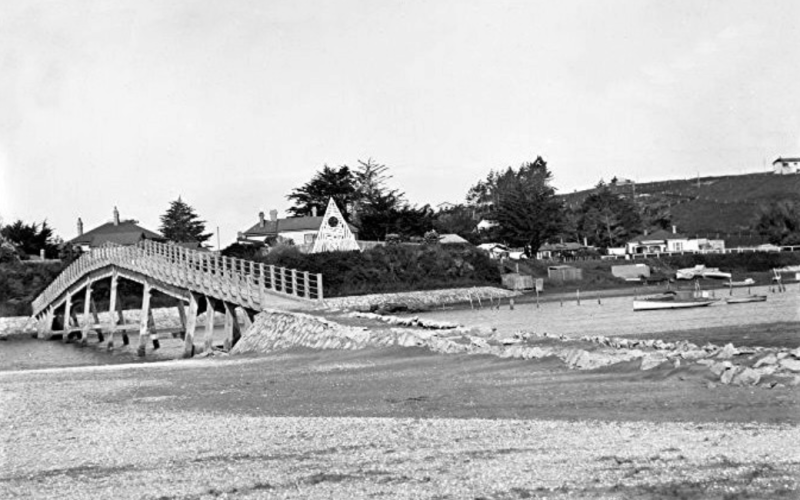
Richard Bollard formally opened the 320 feet, long and 6 feet wide ferroconcrete footbridge, 15 feet above high water, on Saturday 15 May, though it had been in use since the previous Christmas. It was designed by Adams and Jones, Auckland, and built by A Jane, Hamilton. O R Farrar was the supervising engineer. In his ‘Raglan’ book, Bob Vernon wrote, “Unfortunately costs were cut — the foundations were insufficient — it was really built on sand, and that parable is well known to us all. Also salt water and black sand used for mixing with the cement, accelerated the rust problem. It was not many years before chunks of concrete flaked off the piles, leaving the rusting reinforcing exposed to the elements. In 1947, about 18 years after it was built, Council had stripped down the bridge and attempted to patch it. It had not been successful. More reinforcing steel became exposed as concrete continued to flake off.” So the bridge was replaced in 1963 and again in 2011.
Prior to the opening, on 14 May, at a banquet given in the Town Hall, Thomas Parker, as chairman of Raglan Town Board, who had just won an election by 135 to Bill Lusty’s 91, spoke very highly of the MP and his promotion to Minister of Internal Affairs. Mr Bollard didn’t call it the Opotoro bridge, but said he had the honour to open the Kopua Bridge, because it passed over the Kopua Stream. Mrs. Parker cut the ribbon, Mr. Bollard declared it open and there was a welcome and a haka by about 30 Māori. Papahua was a name used on several maps, including the 1905 county map, but doesn’t seem to have been widely known in 1926.
Similarly, Makomako Native school had started on 26 October 1925, but Sir Maui Pomare, Member for Western Maori, officially opened it on 1 February, 1926, with Daniel Stewart Reid, MP for Waikato and Kawhia and Raglan county councillors, The opening at about 10.30am allowed them to travel by launch at high tide along the shallow Maari channel from Aotea harbour. Speaking in te reo Māori, the Minister said: “in addition to 11 native secondary schools and 8 native Mission schools, there are 125 native primary schools with a 1924 roll of 6,346. Average attendance in 1925 was 88.4% at native schools, but in European schools 90.6%.” The Education Department spent over £2,500 to open the school and made a further grant to level an acre as a playing ground. Makomako closed in 1984.
Karamu Caves, which were discovered about 1925, had some publicity in 1926 for an, “immense chamber with its great organ of pure white limestone, its domed roof, and wonderful acoustic properties.”
As usual there were several births, marriages and deaths and a couple of bankruptcies in 1926, including St. Alban’s Church, Waingaro with its first wedding on August 21, when Mary Parsons, of Tunaroa, Waingaro, married Thursby Whitfield, of Korakonui. However, by and large the trends of previous years continued.
For previous Sands of Time articles see – 1925, 1924, 1923, 1922, 1921, 1920, 1919, 1918, 1917 and pt 2, 1916, 1914, 1913, 1912, 1911, 1910