




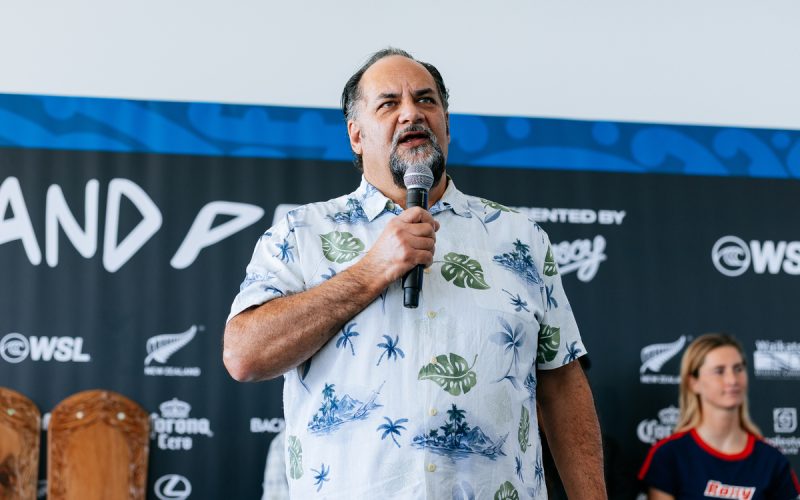
Local frustration over Raglan Lawns no longer mowing council-owned open spaces around town has prompted questions about how Waikato District Council awards its contracts and whether recent changes to procurement have worked as intended for smaller contractors.
Mayor Aksel Bech told Raglan Community Radio the change was not the result of council simply replacing Raglan Lawns with another mower.
Under the previous system, CityCare held one large 10-year contract covering parks and reserves across the entire Waikato district, with Raglan Lawns carrying out local mowing as a subcontractor.
Mayor Aksel said the old contract bundled together everything from mowing and sports fields to cemeteries and other public-space maintenance, making it too large for most smaller businesses to bid for directly.
“Raglan Lawns can’t possibly contract to provide cemetery services at Tuakau,” he said as an example.
When that contract expired, council deliberately broke the work into six smaller packages, with three covering the north and three the south.
The intention was to give smaller contractors two possible routes into the work. They could team up with other businesses and bid for one of the smaller packages themselves, or seek subcontracting work from whichever company won.
Downer ultimately won the southern parks and reserves mowing contract and then made its own subcontracting arrangements. Raglan Lawns did not end up retaining the Raglan mowing work.
Aksel said he had no visibility of the commercial discussions between Downer and Raglan Lawns.
He acknowledged there was an awkward tension in the model, because a smaller contractor could first compete against a major company for the main contract, then have to negotiate with that same company for subcontracting work if it lost.
For Raglan Lawns, neither route ultimately resulted in it continuing the town’s council mowing work.
Aksel said council had been trying to create more opportunities for smaller businesses and had previously pursued “social procurement”, aimed at keeping more council spending circulating locally.
New contract cheaper and easier to compare
Breaking one large contract into several smaller ones created more work for council, but Aksel said it also made it easier to compare contractors and assess how well they were performing.
Under the old district-wide model, failures could be picked up through complaints and service requests, but it was harder to judge overall performance when there was little to compare it with.
Aksel said the new contracting model had also produced a lower-than-expected cost, with the open-spaces contract coming in “significantly cheaper” than council had anticipated. He described this as an example of reducing costs without necessarily reducing services.
Council has also made a significant change with two of the six open-spaces packages, bringing playground and structures work in-house rather than awarding it through the larger external contracts.
Aksel said the work would be managed locally, likening it to an old-fashioned “town clerk” model where someone who knows the community can deal with smaller maintenance jobs directly rather than putting every task through a larger contracting process.
Bigger question over local decision-making
The Raglan Lawns debate also feeds into a wider question Aksel says council should keep exploring: how much decision-making and funding should sit closer to individual communities.
The Government’s Head Start local government reform programme has been paused until after the election, leaving Waikato District’s Western Waikato proposal on hold.
Aksel said councils had worked to what he described as an “impossible timeline” and he was disappointed the Government had not progressed the proposals, but believed the pause should not stop work on local governance.
He said the challenge was to work out what genuine local representation looked like and how decision-making powers could be matched with the funding needed to carry them out.
For Raglan, having more local say over who delivers services such as mowing provides a practical example of what local decision-making could look like.
Rates cap could mean communities choose service levels
Aksel said Waikato District was already forecasting rates increases within the Government’s proposed cap and had so far found savings largely through more efficient spending and contracting.
But he said there was a limit to how much could be achieved through efficiencies alone while costs such as roading and materials continued to rise. Roading is one pressure, with Infometrics forecasting bitumen costs to rise by around 43% per annum.
Once those savings were exhausted, staying within the cap could increasingly mean discussions about the level of service communities were prepared to pay for.
Aksel said the next Long Term Plan discussion would be important because council did not want to decide on service reductions in isolation. He said the aim was to hear directly from communities about which services they value, where they might accept changes and where they would prefer council to keep spending.
“That’s the LTP discussion,” he said.
Aksel used mowing as an example rather than a confirmed cut.
Sports fields still need to be maintained to particular standards, but council could potentially reduce the frequency of mowing on some general berms or open spaces.
He said small changes of that kind could add up to tens of thousands of dollars when applied across the district.
He also described the rates cap as a “blunt tool”, noting that its calculation includes costs such as infrastructure depreciation and penalties charged on late rates payments.
Aksel also said rising replacement costs can increase the value of assets such as roads and therefore the amount council must provide for depreciation. He estimated that revaluing the roading network could account for around one percentage point of a 4% rates cap, effectively using up a quarter of the allowable increase before any change in services.
A bed levy for Raglan?
Aksel also backed exploring ways visitors could contribute more towards the facilities and infrastructure they use in tourism-heavy communities.
He said Raglan clearly benefited from visitors, but those benefits were not shared equally while local ratepayers still carried much of the cost of public infrastructure.
“If we can leave a bit more of that money by way of a levy … then we’re all for it,” he said.
The discussion follows National’s decision to rule out a bed tax and instead propose sharing more revenue from the existing International Visitor Conservation and Tourism Levy with councils if it is re-elected.
Under the policy, councils would receive funding based on their share of international visitor guest nights. That would still leave domestic visitors outside the funding mechanism. National itself says domestic travellers account for around two-thirds of guest nights nationally.
For Raglan, Aksel said a bed levy could potentially capture a wider share of visitors because many come from elsewhere in New Zealand as well as overseas.
Council was open to considering any mechanism permitted under existing legislation, he said, although targeted rates and similar charges would themselves count towards the proposed rates cap.
Government asked again to help communities host WSL
Aksel said council had again asked the Government to consider funding host communities alongside major events such as the World Surf League Championship Tour.
The WSL will return to Raglan in 2027. Aksel said council had sought Government support for the community around this year’s event, joking that he was “still waiting” for a response even though the event was already over.
Council has since repeated the broader request, arguing that Government support for major events should also recognise the costs and work carried by host communities.
Aksel praised the local destination management organisation and Raglan Naturally for the economic and wider social impact work carried out after this year’s event.
He said both council and central government had lessons to take from the first event, including around local communications, regulation and preparing communities to host events of that scale.
Water company brings savings but less direct control
The question of local control also came up in discussion about IAWAI Flowing Waters, the water services company jointly owned by Waikato District and Hamilton City councils.
Aksel said combining water services had already produced economies of scale and reduced the increase in fixed water charges compared with earlier projections.
But he acknowledged there was a trade-off.
“We gave something away as well. We gave away the decision-making power directly,” he said.
Councils now influence the company as shareholders rather than elected members directly making operational decisions.
That distinction has become apparent through a request connected with the University of Waikato’s proposed medical school for relief from development contributions.
Development contributions are charges on new developments to help pay for infrastructure such as water, wastewater, roads and community facilities that existing ratepayers have already funded.
Aksel said the decision now sits with IAWAI rather than Hamilton City Council.
He said Waikato District had previously supported considering relief for developments such as affordable housing, pensioner housing and papakāinga because of their social purpose.
He did not personally see the medical school as fitting the same category, but said the wider issue was where the line should be drawn when a development claimed broader public benefit.
