



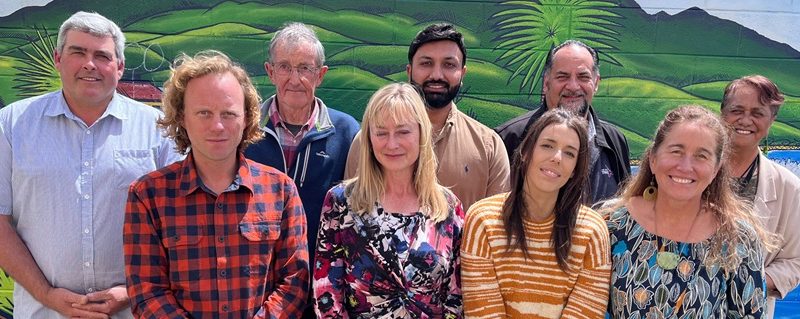
Raglan Community Board chair Ross Wallis says Raglan is at a point where longer-term, community-led planning can begin to shape how the town develops for future generations.
Speaking after the board’s first full meeting following the local elections, Ross said the discussion reflected a growing awareness that many of the pressures Raglan faces — from growth and infrastructure to environmental protection — cannot be solved through short-term or piecemeal decisions.
“Let’s not think about 10, 15, 20 years,” he said. “Let’s think 50, 100 years, so that we actually build properly for the future and future generations.”
Ross said the timing was significant, with a new mayor, a new chief executive and restructuring under way at council. He described the changes as an opportunity to improve how decisions are made and how communities are involved, noting early signs of optimism among staff as systems and culture evolve.
Learning from recent projects
One of the clearest themes from the community board meeting was the importance of involving local communities earlier in projects, rather than after plans and budgets are already set.
Ross said recent experiences had shown that late engagement often leads to repeated redesign, increased consultant involvement, and unnecessary cost. Using the Greenslade Reserve playground as an example, he said the back-and-forth between council and community could have been reduced with clearer early conversations about expectations, budget limits, and design preferences.
That lesson extended to other infrastructure projects, including a pedestrian bridge that replaced an earlier community-built structure. Ross said the contrast in costs highlighted the challenge councils face in balancing health and safety requirements with cost-effective, locally driven solutions.
He said the Mayor has started making in-roads towards finding ways for smaller, low-risk projects to be delivered locally, provided safety standards could still be met, particularly during a period when council processes are being reviewed.
Making space for community voices
The board also discussed how accessible community board meetings are, including whether the long-standing 1.30pm Wednesday meeting time still works for residents, especially those working standard hours.
Ross said the board had decided not to make immediate changes, but instead to seek informal feedback from community networks about whether different times or formats would encourage greater participation.
He said holding some meetings in Te Uku and Te Mata during the year was also part of making the board more visible and accessible across the wider ward.
Transport issues were also raised in the public forum, including a proposed internal bus trial led by Waikato Regional Council. Ross acknowledged frustration about slow progress and the impact of staff turnover across councils, but said the board would continue to push for clarity and coordination.
Rural infrastructure and funding
Rural issues featured strongly in the discussion, including the discovery that rural properties added to the Raglan ward through a boundary change had not been contributing to the Raglan discretionary fund.
Ross said council staff were reviewing how the oversight occurred and what it might mean for future funding, noting that the discretionary fund supports a range of community projects and facilities.
He said there was a general sense that rural residents would be willing to contribute, particularly where funding supports assets and services used by the wider Raglan community.
Sealing of unsealed rural roads was also discussed, with Ross noting strong community interest but acknowledging that cost remains a major constraint with council staff advising that sealing the road requires a significantly higher level of investment. He said recent improvements to drainage, culverts, and road foundations showed a shift toward more proactive maintenance, even where full sealing was not currently feasible.
Planning the town’s future
Looking further ahead, Ross said early work on long-term planning for Wainui Reserve would begin in the new year, starting with broad community conversations rather than predetermined designs.
He said the aim was to understand what the community values most about the reserve — including access, recreation, and environmental protection — before any plans are developed.
Ross said these discussions are closely linked to broader questions about how Raglan grows and functions as a town, particularly as visitor numbers increase and pressure on public spaces grows.
He said parking is often treated as a technical or logistical problem, when it is really a question about what kind of place Raglan wants to be.
“Do we want a whole lot more parking in town, or do we want it to be more pedestrian and so parking’s pushed out, and we walk in, or scooter in?” he said.
Environmental pressures and stormwater
Environmental pressures were also raised at the meeting, particularly stormwater and its impact on harbour water quality.
Ross said stormwater runoff from roads and streets remains one of Raglan’s biggest challenges, especially after heavy rain, now that the wastewater treatment plant is performing well.
He said a stormwater liaison group, originally established as part of consent conditions, was scheduled to meet again, noting that regular engagement would be important to ensure local knowledge and concerns are reflected in ongoing work, after several years in which the group had not met consistently.
Ross said upgrades to some stormwater infrastructure, such as old pumps, were under way, but emphasised that community involvement would remain critical as solutions are developed.
Heading into summer
Summer pressures were also discussed, including rubbish management, visitor behaviour, and enforcement.
Ross praised Xtreme Zero Waste’s planning for the busy season, noting regular collections in high-use areas, and encouraged residents and visitors alike to take responsibility for their rubbish.
Police, who were unable to attend the meeting, advised there would be an increased presence in Raglan over summer to help manage peak-period pressures.
As the holiday season begins, Ross said he would remain available to respond to urgent issues and encouraged people to enjoy Raglan responsibly.
“Enjoy the summer, the swimming, the fishing,” he said. “Just be safe out there.”