



Waikato District Mayor Aksel Bech says communities like Raglan could feel the effects of sweeping local government reforms well beyond Wellington, as councils grapple with funding uncertainty, pressure on community services and changes to how decisions are made locally.
Speaking on Raglan Community Radio’s Morning Show, the Mayor described a reform agenda being driven by central government unlike anything councils have faced in a generation. He said councils are currently being asked to respond to around ten separate pieces of legislation or policy initiatives at the same time, creating significant complexity and uncertainty about how the changes are intended to work together.He said the volume and pace of reform made it difficult for councils to assess whether promised efficiencies would actually be realised.
Regional change, local consequences
One of the most significant proposals is the removal of Regional Councillors as a layer of governance. The Mayor said this does not amount to the abolition of regional functions, but rather the removal of regional council governance structures, with functions to be redistributed.
He explained that some responsibilities may be absorbed by central government agencies, while others will be transferred to new combined territorial boards made up of mayors. However, he said councils do not yet know which functions will go where, how many staff may transfer, or whether funding will follow the functions.
“We don’t know what’s going to be handed over. How many staff come with it. Will that be inside the rate cap? Will we get the regional council rates with it, or some of it?” the Mayor said, adding that councils are unlikely to have clarity for many months.
Rate caps and affordability pressures
The Mayor also raised concerns about the Government’s proposed rates-capping regime, which he said risks giving a misleading impression of affordability.
He said water infrastructure costs – including drinking water and wastewater – sit outside the cap, despite being the fastest-growing part of council expenditure. Fees and charges, such as building consents and licensing fees, are also excluded.
“The biggest increases actually will be in that waters targeted rate. That’s the largest threat to affordability,” the Mayor said, noting that these costs are not captured by the cap at all.
It comes as Waikato District ratepayers are already facing significant long-term increases in wastewater charges, after central government placed the cost of three-waters upgrades directly onto councils and ratepayers. For urban communities within the district, wastewater is already the single largest component of rates, with council projections showing those charges set to roughly double over the next decade to meet upgraded treatment and compliance requirements.
From a ratepayer’s perspective, the Mayor said, the distinction between capped and uncapped charges is largely academic.
“When people look at their rates bill, they look at the number down at that bottom right-hand corner,” he said.
Shared services move from option to necessity
The Mayor said the combined pressure of rate caps, rising costs, and additional responsibilities means councils will be forced to pursue shared services and amalgamation of back-office functions more aggressively.
He pointed to the Waikato region, where multiple councils each operate their own executive teams, finance departments, billing systems, and communications functions, despite collectively serving a population smaller than Auckland.
“You’ve got four CEOs, four CFOs, all billing teams, marketing teams – and all of it’s smaller than the size of Auckland,” the Mayor said, arguing that the cost per ratepayer is too high under the current model.
This pressure is already shaping council decisions. Waikato District Council has recently cancelled a major IT project partway through its rollout after determining it would not support future shared-service arrangements.
“I’d rather walk away from some thousands of sunk costs versus spending millions on something which, in two or three years, will be pointless,” the Mayor said.
“Fit for purpose” over higher specification
The Mayor said councils also need to reassess how they approach infrastructure projects, particularly in light of affordability pressures.
He acknowledged that higher-specification builds can offer long-term durability, but said councils must now focus on delivering services that meet requirements without unnecessary cost.
“At the moment, where rates are at and where our community is at, we just have to do fit for purpose – and that’s good enough,” he said.
Culture change under way
The Mayor said pressure for change at Waikato District Council did not begin with the latest wave of central government reform.
He said he was elected on a platform of changing how the council operates, including improving efficiency, accountability and the way decisions are made, which is why questions around council culture have been raised early in his term.
However, he said the scale of reform now being driven by central government has made change unavoidable, regardless of internal preferences or political cycles.
“This shake-up is too big for that,” the Mayor said, referring to suggestions that councils or staff might simply wait for the reforms to pass. He added that the direction of travel is unlikely to be fully reversed even under a future government.
While elected members cannot directly manage council staff, the Mayor said the combination of political direction, legislative change and financial pressure means organisational culture will inevitably shift.
He said Waikato District Council’s chief executive was already leading a transformation programme, but that the Government’s reform agenda has significantly accelerated the need to rethink how council works, how services are delivered and how resources are prioritised.
Bringing decisions closer to communities
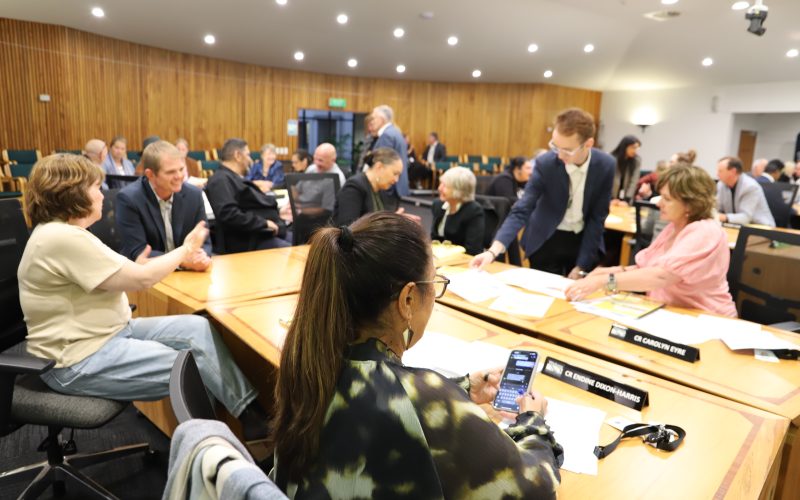
Against this backdrop, the Mayor said Waikato District Council is attempting to strengthen local decision-making by holding more hearings and governance meetings in the communities affected by them.
Recent bylaw hearings, governance meetings, and water-related discussions have been held in Raglan, alongside the introduction of public forum time at full council meetings and efforts to maintain live-streaming access.
He said empowering communities is an important safeguard as reforms centralise some functions and decision-making.
“The ultimate protection against what might be government overreach is an empowered community,” the Mayor said.
What’s Next on Mayor’s Agenda
What might normally have been a moment to outline the new Mayor’s priorities for the year ahead has instead become a race to respond to central government reforms already moving through Parliament.
The Mayor said his immediate focus after the Christmas break will be on preparing submissions on the raft of reform proposals now before councils, with multiple consultation deadlines falling within weeks of each other.
Rates-capping submissions close in early February, with several other consultations following later in the month. Council staff will spend the summer period analysing how the proposed changes interact, while elected members work to understand what the combined reforms could mean for local services, budgets and governance.
Rather than setting a clear policy agenda for his first year, the Mayor said much of the council’s attention is now being consumed by responding to reforms being driven from Wellington.
“It’s really messy,” the Mayor said. “But it is fundamentally changing the way local government and its services will be delivered.”