




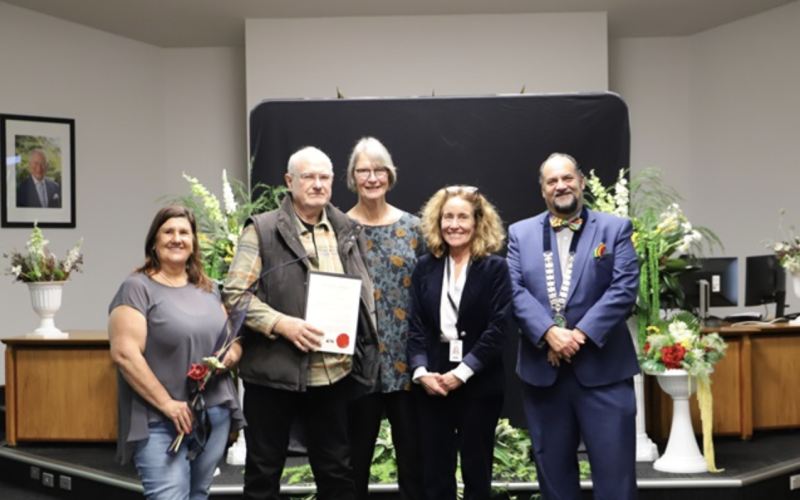
From the wharf and Wainui walkways to playgrounds, libraries and Raglan’s wastewater system, Whaingaroa Ward councillor Lisa Thomson says some of the things residents notice most are shaped by decisions made locally.
Her comments come as Waikato District waits for the Government’s response to a Western Waikato amalgamation proposal developed with Waipā and South Waikato councils. With the future shape of local government still uncertain, Lisa said the debate should also consider which decisions are best made close to the communities they affect.
Speaking to Raglan Community Radio, Lisa pushed back on the idea that councils should be reduced to little more than pipes and roads.
“We’re more than the underground infrastructure that we can’t see,” she said.
She pointed to parks, reserves, sports facilities, beaches, libraries, playgrounds, rubbish collection, weed control and local infrastructure among the services councils provide. In Raglan, she cited the wharf, Papahua pump track, Wainui Reserve walkways and local landscaping.
Local involvement had also shaped larger projects, including the long-running work to move treated wastewater discharge from the harbour to land.
“Local people are best placed to make local decisions,” Lisa said.
More power for local communities
The current system could still do more to give communities genuine decision-making power, according to Lisa.
“We need to be able to devolve more power to our local boards,” she said.
Community boards, or whatever replaces them under a future structure, should have their own resources and budgets so they can make decisions directly affecting their communities.
Lisa supported the principle of subsidiarity, where decisions are made as close as practical to the people affected. But she said communities should be at the centre of decision-making, rather than treated as the bottom tier of government.
“At the heart of any decision making should be the community.”
A future governance system could look quite different from the current council structure, with some councillor responsibilities devolved to local boards or other community-level bodies and a higher tier retaining oversight of issues such as long-term planning, bylaws and risk.
Citizens’ assemblies could be trialled
As chair of Waikato District Council’s Voice and Choice subcommittee, Lisa sees an opportunity to trial citizens’ assemblies and other forms of community decision-making.
Submissions from Raglan and elsewhere in Waikato and South Waikato showed similar priorities around community voice, relationships with hapū and Treaty partnerships.
Lisa suggested communities that had already engaged in the process could begin connecting with each other to compare ideas and identify common ground, without waiting for council or central government to determine what happened next.
“There’s nothing stopping us,” she said. “We don’t need council. We don’t need the Voice and Choice Committee to determine that. We can already do that.”
She also described an overseas example where chairs representing children and the environment were placed in decision-making spaces as a reminder to consider people and interests not physically represented around the table.
Head Start process criticised
Waikato District is now waiting for the Government’s response to the Western Waikato proposal developed with Waipā and South Waikato councils.
While Lisa was positive about the work undertaken by the three councils, she was critical of the process itself.
The three-month timeframe was too short, in her view, and councils received no additional Government resourcing to undertake the work, meaning it had to be absorbed within existing budgets and staff workloads.
Hamilton City and Taupō District chose not to participate in the Head Start process and instead opted for the Government’s backstop process.
It remains unclear how the Government will reconcile those positions with the Western Waikato proposal.
Water bill confusion
Council business has continued alongside the structural debate, including the July transition of water services to IAWAI Flowing Waters.
Some ratepayers interpreted their rates notices as showing a new $1800 water charge on top of what they were already paying.
Lisa acknowledged the confusion. Previously, wastewater and water charges appeared under Waikato District Council, while the move to IAWAI has separated them more clearly.
The change in presentation made some longstanding charges appear new, particularly for households receiving wastewater but not council drinking water.
Waikato District had been considering combined water services for more than a decade, dating back to the 2015 Cranleigh report involving Waikato District, Waipā and Hamilton.
The move to a combined entity was not a new direction, although the new name and billing arrangement had contributed to the confusion.
IAWAI remains council-owned
Lisa also addressed concerns that ratepayers no longer owned their water services after the move to IAWAI.
The company is a council-controlled organisation jointly owned by Waikato District Council and Hamilton City Council.
Lisa said Waikato-Tainui is a partner in IAWAI and has a seat at the table, but does not have voting rights. The IAWAI board is accountable to the councils, which retain oversight of the company.
Major infrastructure planned across the combined network is also expected to benefit Waikato District, including Hamilton’s proposed southern wastewater treatment plant, which will serve both Hamilton City and Waikato District ratepayers.
Further wastewater infrastructure will eventually be required in the district’s north as communities grow.
Water costs reflect years of underinvestment
Decades of underinvestment by both central and local government had contributed to the scale of the water infrastructure challenge now facing communities, Lisa argued.
Planned spending includes treatment upgrades, infrastructure for growth and the introduction of water meters in Hamilton.
Some of those costs had effectively been deferred for years and were now falling on current and future ratepayers.
Lisa rejected suggestions that Waikato District’s rising water costs had appeared without warning, pointing to more than a decade of discussion and planning for major investment.
Raglan’s new wastewater treatment plant and progress towards moving treated wastewater discharge from the harbour to land were examples of what that investment had delivered.
New playground and pump track
A more visible example of council work is the new playground between Greenslade Road and Lorenzen Bay Road.
Council staff worked closely with local contractors on the project, according to Lisa.
The Papahua pump track is also now open, with Lisa acknowledging the council staff and local people involved in completing it.
WSL economic impact released
The local economic impact assessment for the World Surf League Championship Tour event has now been released.
When Lisa spoke to Raglan Community Radio, council had received the report the previous day after funding the assessment, with publication expected alongside the separate community impact study.
